See more stories from Issue 206.
The mortar and pestle remains a staple kitchen tool despite the rise and fall of countless gadgets. While devices like bread makers and spiralizers have faded from use, this ancient instrument continues to endure due to its simplicity and tactile appeal.
Its basic design, a bowl and a clublike pestle, allows for grinding spices, herbs, and aromatics by hand, creating a direct, physical connection to food preparation.
Historical roots of the mortar and pestle trace back to around 35,000 B.C.E. in Southwest Asia and the Middle East. The Egyptian Ebers Papyrus, one of the oldest known medical texts, illustrates that porcelain models have been a chemist’s BFF since around 1550 B.C.E. Despite the tool’s undeniable influence in the medical area (remember the old Walgreens logo?), it’s the mortar and pestle’s many uses in food preparation that have given it true staying power.
Read Also: Hasan Minhaj Praises America’s Cereal, Shares Food Memories
Varied Designs Across Cultures
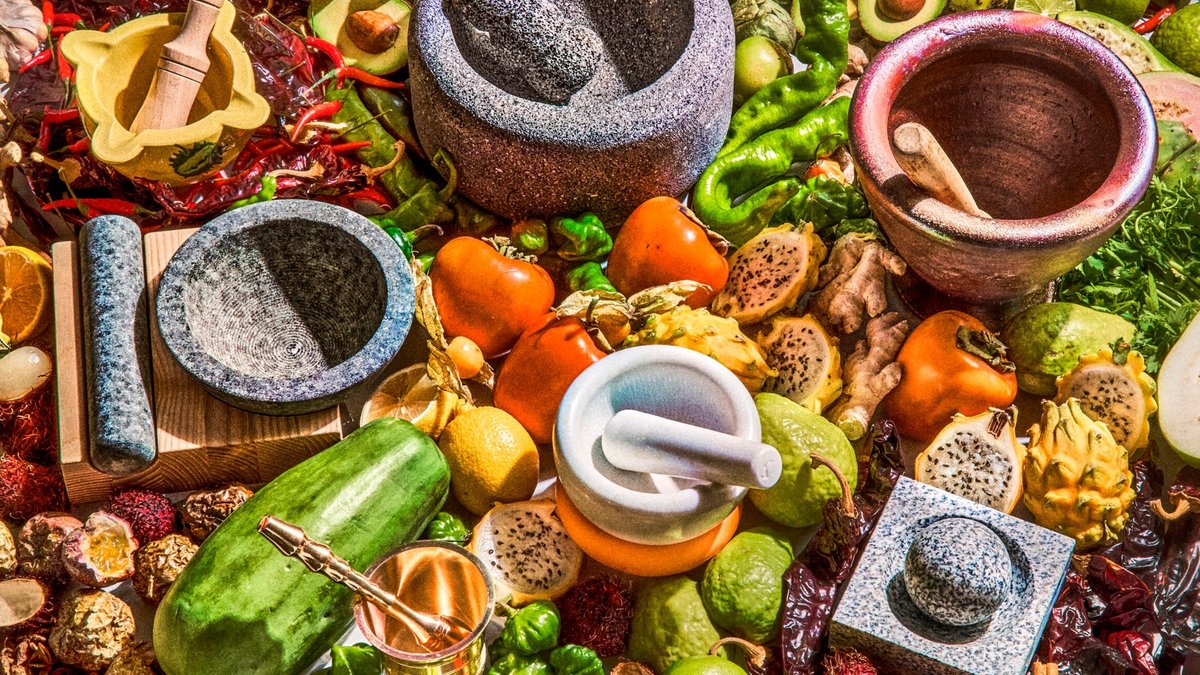
Size, material, and style differ widely across regions. In Mexico, the molcajete, a volcanic stone mortar, has been used for about 8,000 years. Japan’s suribachi, with its ridged interior, arrived via Chinese traders in the 11th century. In early 20th-century Papua New Guinea, dap daps were long and thin, and often used for crushing betel nuts. The super-size Middle Eastern jeren can weigh up to 100 pounds, showcasing the tool’s adaptability.
Materials range from clay and brass to granite and volcanic stone, all of which turn smashing spices into a tactile pleasure. Thai artisans craft oversized krok mortars from glazed terra-cotta, designed for bruising ingredients like those in som tum, a green papaya salad. Granite mortars, such as Loisa Mortar y Pestle, combine durability with ergonomic features like a spout and silicone base.
Modern Innovations and Cultural Craftsmanship
Indigenous Mexican traditions continue with molcajetes, such as those made by Don Enrique of San Salvador El Seco from volcanic rock. For design-focused users, Case Furniture’s Orb Pestle and Mortar blends form and function, crafted from food-safe granite by craftsman Gareth Neal. In India, brass okhli musal tools are favored for their corrosion resistance, ideal for crushing cardamom pods; mortars and pestles made of brass aren’t unique to India but are certainly popular there. The metal’s low corrosive quality makes it ideal for pulverizing herbs, and the steep-sided cup is handy for crushing cardamom pods without sending them flying.


